
What are the top three lesser-known API 682 piping plans worth knowing?
Keeping mechanical seals operating reliably depends as much on the seal support system as on the seal itself. API 682, 4th edition, recognises thirty-two different piping plans, each designed to deliver optimal conditions around the seal faces for a specific seal arrangement, process fluid and operating challenge.
In practice, only a small number of these plans are used regularly. Their popularity often comes down to familiarity, ease of implementation and suitability for common services. As a result, several piping plans are rarely specified and often overlooked during system selection, even though their features can solve problems that more familiar plans struggle to address.
Some API 682 piping plans are specified far less often than others, not because they lack value, but because their benefits are less well known. Recognising how these plans operate and where they are most effective expands the range of viable seal support system options.
Understanding the context of lesser-known piping plans
API 682 piping plans outline the arrangement of auxiliary piping and equipment surrounding a mechanical seal. Their purpose is to ensure the seal receives adequate lubrication, cooling, and pressure control while safely managing leakage.
Among the thirty-two recognised plans, a handful dominate everyday use. Simpler arrangements, such as single-flush plans or basic dual-seal systems, are well understood and widely applied. However, some services introduce challenges that these common plans can’t fully address, such as:
- Gas accumulation in the seal chamber
- Mixed-phase leakage from dual seals
- Variable operating pressures that place unnecessary load on seals
In these cases, lesser-known piping plans can offer effective solutions without resorting to more complex or heavily engineered alternatives. The following three plans demonstrate how specific design features can overcome niche challenges.
Plan 14 – combining discharge flush and suction return
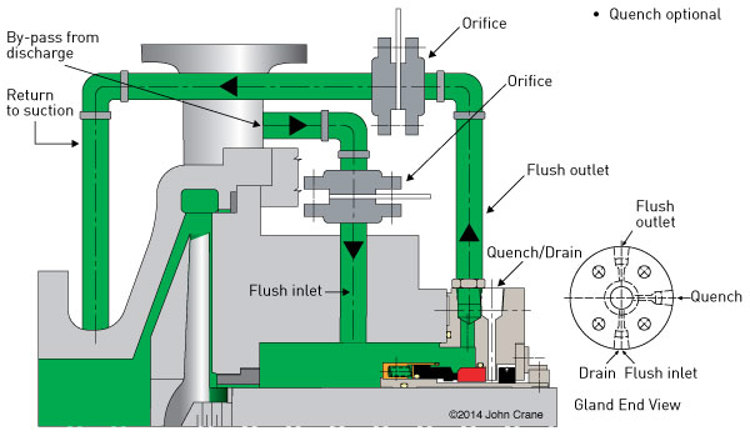
Plan 14 is an inboard piping plan that combines two flow paths to create controlled circulation of process fluid across the mechanical seal.
How does Plan 14 work?
Plan 14 uses two separate connections between the pump and the seal chamber:
- One pipe connects the seal chamber to the pump suction. As the pump operates, the higher pressure in the seal chamber drives flow through this pipe back to suction.
- A second pipe connects the pump discharge to the seal chamber. The higher discharge pressure draws process fluid into the seal chamber.
Together, these connections create a continuous circulation path from discharge, across the mechanical seal and back to suction. This circulating flow performs two essential functions:
- It provides a continuous supply of liquid to lubricate the seal faces.
- It removes heat generated by friction at the seal faces.
Orifices are typically installed in the piping to limit flow rates and protect the seal from full discharge pressure.
Why is Plan 14 chosen less often?
In many applications, engineers default to simpler alternatives:
Compared with these options, Plan 14 requires additional piping and fittings. It may also require the mechanical seal to be axially longer to accommodate two flush ports. These factors can lead to Plan 14 being excluded early in the design process.
Why Plan 14 deserves more attention
Plan 14 combines the advantages of both Plan 11 and Plan 13:
- Plan 11 can provide a healthy flow rate but may allow gases to accumulate in the seal chamber, particularly in vertical pumps.
- Plan 13 can help remove gases but may struggle to induce sufficient flow to cool the seal effectively.
By combining both flow paths, Plan 14 can remove accumulated gases while maintaining an excellent circulation rate. This makes it a valuable option for avoiding more complex solutions, such as cooled piping plans, when the primary concern is seal cooling and lubrication. It can also help prevent mechanical seals from running dry, which is a common cause of premature failure.
Plan 75 – managing leakage from unpressurised dual seals
Plan 75 is designed for dual unpressurised mechanical seals, also known as arrangement two seals. Its purpose is to safely manage leakage from the inboard seal without relying on a liquid buffer system.
How does Plan 75 work?
In a Plan 75 system, the space between the two mechanical seals is connected to a containment vessel located below the seal. This connection is made through a drain port at the bottom of the seal.
As the pump operates:
- Process fluid that leaks across the inboard seal is contained by the outboard seal.
- Liquid leakage drains into the containment vessel, where it is safely collected.
- A level transmitter continuously monitors the liquid level in the vessel. When the vessel reaches a predefined level, an alarm alerts operators to drain the collected liquid to a safe disposal system.
Vapour leakage follows a different path:
- Vapours pass into the vessel and exit through a vent connection.
- The vent is routed to a safe vent or flare system for controlled disposal of hazardous emissions.
- A pressure transmitter monitors vapour build-up and triggers an alarm if abnormal pressure indicates seal damage.
Why is Plan 75 chosen less often?
Plan 75 is less widely known than the more traditional arrangement 2 piping plans. Many engineers instinctively specify Plan 52, which remains the most familiar unpressurised dual seal arrangement.
There can also be practical installation constraints. Plan 75 requires sufficient space below the pump shaft to install the leakage collection vessel, which is not always available.
Why Plan 75 stands out?
For arrangement 2, which handles liquid leakage or mixed liquid and vapour leakage, Plan 75 offers strong performance. It provides clear separation and safe handling of both phases without the need for a buffer liquid system.
Additional advantages include:
- No requirement for a heat exchanger, as there is no buffer liquid to cool.
- Compatibility with dry-running secondary containment seals.
- The option to add Plan 72, introducing a low-pressure nitrogen purge that further restricts process emissions and supports non-contacting containment seals.
By eliminating the need to maintain a buffer liquid, Plan 75 simplifies thermal management while enabling effective leakage control for challenging services.
Plan 53C – pressure tracking with a piston accumulator
Plan 53C is a pressurised dual seal piping plan that uses a piston accumulator to maintain barrier fluid pressure above seal chamber pressure.
How does Plan 53C work?
In a Plan 53C system, the space between the two seals is connected to a heat exchanger in a closed loop. This loop is filled with a clean barrier liquid.
Key elements of the system include:
- A circulating device built into the mechanical seal induces flow of the barrier liquid as the pump operates.
- A heat exchanger, which removes heat from the circulating barrier fluid before it returns to the seal.
- A piston accumulator is connected via a reference line to the seal chamber.
The piston accumulator is the part that distinguishes the Plan 53C from other solutions. It uses an area differential to apply pressure to the barrier liquid. This ensures the barrier pressure remains higher than the seal chamber pressure. As seal chamber pressure changes, the piston automatically adjusts barrier pressure.
Because the barrier liquid is always at a higher pressure:
- Process fluid is prevented from leaking across the inboard seal.
- Process emissions are eliminated.
- Both seals are lubricated by clean barrier fluid, although a small amount of barrier liquid is injected into the process stream.
Continuous monitoring is provided by level and pressure transmitters, which trigger alarms when critical limits are reached.
Why is Plan 53C chosen less often?
Challenges with the piston accumulator often discourage selecting this plan. Some operators are concerned that solids in the process fluid could travel through the reference line and clog the piston. This can lead to Plan 53C being avoided, even in services where the process fluid is sufficiently clean.
Others cite perceived system complexity. Although the system performs a sophisticated function, its operation is automatic and typically requires minimal operator intervention once commissioned.
Why Plan 53C merits consideration
Plan 53C offers a key advantage over other pressurised dual seal systems: it tracks seal chamber pressure directly. This means the barrier pressure is only as high as necessary, rather than being set to a fixed margin.
This characteristic delivers several benefits:
- Reduced mechanical load on the seals when operating pressures are low.
- Improved seal life through minimised differential pressure.
- Effective performance across pumps that operate at varying duty points.
Since pressure is generated hydraulically rather than through a pressurising gas, Plan 53C can reliably achieve extremely high pressures. This makes it suitable for demanding services where pressure flexibility and emission elimination are critical.
Why familiarity should not limit piping plan selection
The popularity of specific API 682 piping plans does not always reflect their suitability for every application. Lesser-known plans often exist to address extremely specific challenges, many of which arise in modern process environments.
By broadening awareness of plans such as 14, 75 and 53C, engineers and operators can:
- Avoid unnecessary complexity by selecting a plan that directly addresses the issue at hand.
- Enhance mechanical seal reliability by optimising lubrication, cooling or pressure control.
- Enhance safety and emissions management by choosing plans designed for specific leakage behaviours.
These piping plans may not be appropriate for every service, but understanding their capabilities ensures they are not overlooked simply due to a lack of familiarity.
A broader perspective on API 682 piping plans
Understanding how these plans function and where they add value helps ensure seal support systems are selected based on application needs rather than habit.
Across oil and gas applications, John Crane provides mechanical seals and seal support systems, backed by application expertise, to meet API 682 piping plan requirements. Further information on these and other API 682 piping plans is available here.