
8 things to know about API 692 seal gas systems
Seal gas systems are essential for the safe operation of dry gas seals and contribute significantly to overall compressor reliability. The standard was developed collaboratively by seal manufacturers, OEM specialists and end users to formalise best practices for seal gas system design and operation.
Below, we outline what’s new in API 692, including the updates that impact seal gas, nitrogen usage and vent system monitoring.
1. What is a dry gas seal system?
At their core, dry gas seal systems do two main jobs:
- Provide a clean and conditioned environment for the dry gas seals
- Monitor the health of the dry gas seal
To accomplish these goals, the dry gas seal system is usually broken down into separate independent modules that regulate and monitor five streams for tandem seals and four streams for double seals.
2. Seal gas
(Sometimes referred to as buffer gas.)
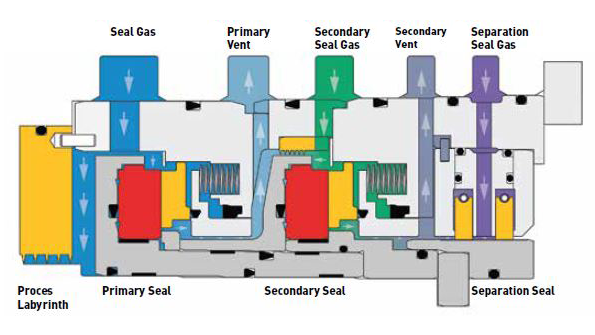
Also known as buffer gas, seal gas flows across the primary seal (inboard stage) of the dry gas seal out towards the primary vent, and across the inboard process labyrinth, back into the process. Seal gas prevents dirty, unfiltered process gas from entering the dry gas seal. This gas must be filtered, cleaned and conditioned to be completely dry and free of particulate contamination.
The conditioning is usually accomplished via the addition of:
- Filters
- Gas separators
- Gas boosters
- Heaters
3. Secondary seal gas
(Only applies to tandem seals; sometimes referred to as buffer gas, intermediate injection or intermediate gas.)
Secondary seal gas flows across the secondary seal (outboard stage) of a tandem dry gas seal and out the secondary vent, as well as across the intermediate labyrinth and out the primary vent. API 692 now standardises the use of this stream, even though not all systems include it.
Typically nitrogen, this gas must also be cleaned and filtered to ensure it is dry and free from particulate matter. Secondary seal gas offers numerous benefits, including significantly improving the ability to monitor the health of the secondary seal.
4. Separation seal gas
Separation seal gas is injected between the two separation seal elements, providing a barrier between the atmospheric bearing housing and the dry gas seal. If a labyrinth, it is injected between the two sections of teeth if a carbon ring type seal (Type 93LR, Type 93FR, Type 83), then between a pair of carbon rings.
Although nitrogen is the most common, air may be used. Particular care must be taken to avoid creating explosive mixtures in the secondary vent. These can be pressure or flow-controlled depending on customer preference.
5. Primary vent
The primary vent consists of leakage from the primary seal, plus any secondary seal gas flow if present. Typically, seal monitoring is performed via the primary vent. The primary vent will usually feature flowmeters and pressure transmitters that monitor seal health via the leakage. Leakage is often a major indicator of seal health, and most alarm settings are based on a multiple of leakage (e.g., 10x guaranteed leakage).
6. Secondary vent
A secondary vent is an atmospheric or near-atmospheric outlet where leakage from the secondary and separation seals is released. It must remain unrestricted to avoid backpressure that can damage the seal.
The secondary vent is the most safety-critical stream. Differential pressures across secondary gas seals are generally small, and any backpressure generated in the secondary vent could easily reverse pressurise the secondary seal.
Flowrates should be extremely low, and pressure should remain close to atmospheric. API 692 allows but does not require flow or pressure monitoring here.
7. API 692 enforces new flowmeter requirements
While the vast majority of API 692 merely codifies best practices, one significant departure in system design is the requirement to include flowmeters in every supply line.
Historically, there might have been limited flow monitoring of the seal gas stream, or none at all, with the only flow meters being in the primary vent. The additional flow monitoring vastly improves the system’s fidelity and helps with diagnostics of seal performance anomalies in the field by providing more information about flows within the seal.
8. Gas conditioning units (GCUs) have substantial new requirements
One of the leading causes of gas seal failure is improperly conditioned gas entering the seals. All gas must be both clean and dry, before it goes across seal faces. GCUs condition the gas protecting the seal.
GCUs are typically made up of four items:
- Filters (coalescing and separators)
- Heaters
- Boosters
- Coolers
The most significant change is that these items should be considered standard. Sufficient justification must be made by the system vendor not to include these components.
API 692 imposes a few new requirements on systems as described above, with the major changes involving requirements surrounding monitoring and the gas conditioning unit. However, the standard does not require a radical departure from what already exists.
As with any new project, careful consideration should be taken to understand the real-world value of the design versus the cost of the initial purchase, improved reliability and reduction of downtime due to unplanned maintenance.
Common questions
What is API and what does it stand for?
API stands for the American Petroleum Institute, the industry body that develops standards and best practices for equipment, safety and performance in the oil and gas sector. Standards like API 692 ensure reliability, consistency and safe operation across global energy systems.
What is a compressor seal gas system?
A compressor seal gas system supplies clean, dry gas to dry gas seals to prevent contaminated process gas from entering the seal. It conditions, regulates and monitors gas flows to protect the seals. Maintain efficiency and reduce the risk of compressor failure.
When using nitrogen in repairing a seal, what should you consider?
When using nitrogen to repair a seal, ensure the gas is clean, dry and properly regulated. Nitrogen must not introduce moisture or contaminants, and the system should be fully purged to prevent oxygen entrapment or unsafe mixtures before restarting the compressor.