
Why the groove makes all the difference
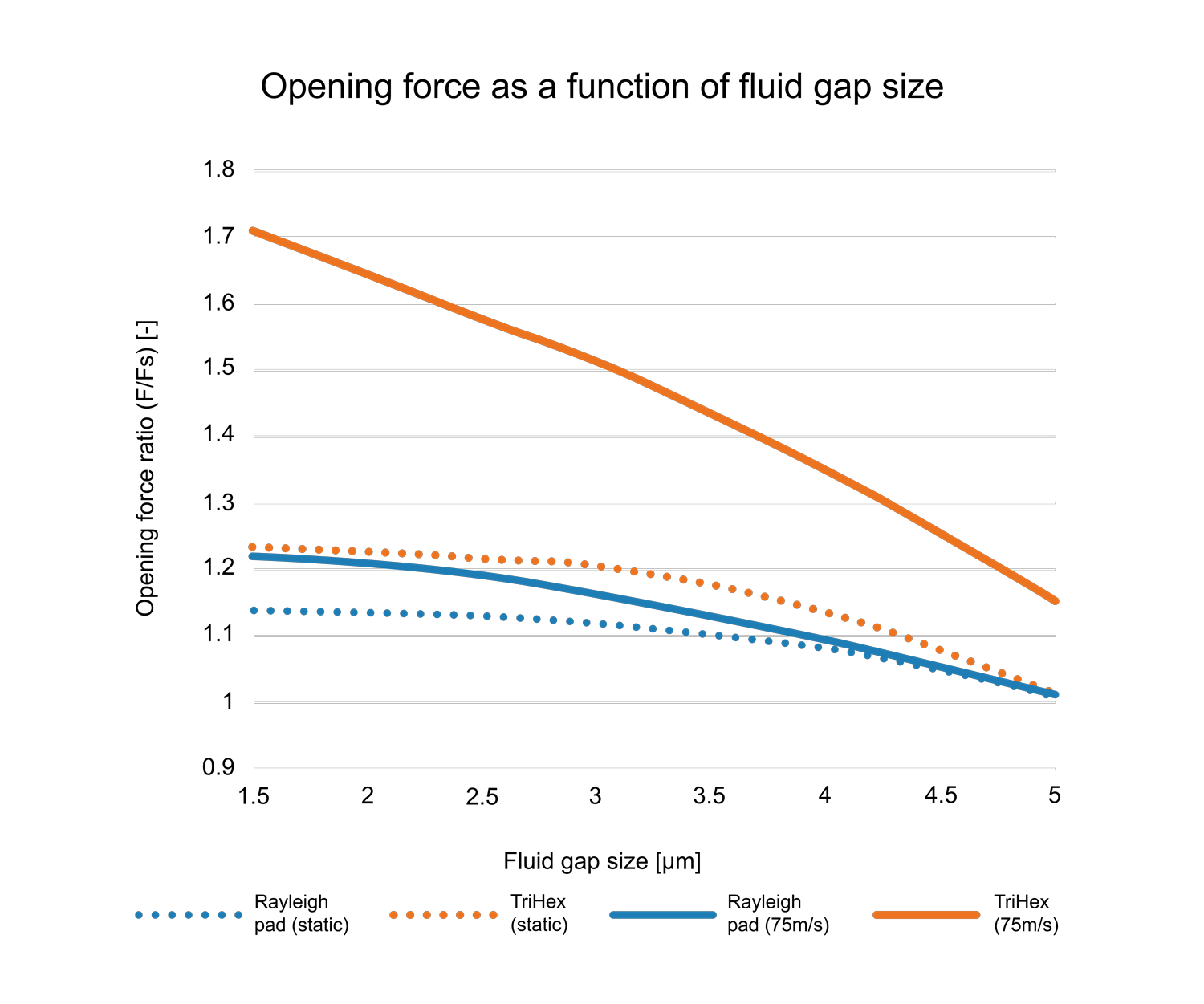
In coaxial separation seals, stability comes down to a few microns of gas film. When that film is strong and well-behaved, the seal runs smoothly. When it weakens, things can change fast. The opening-force curve, how the seal reacts as the gap becomes smaller, reveals exactly how robust that film really is.
The comparison between a traditional continuous groove and the TriHex discontinuous groove tells a clear story. At first glance, both designs seem similar. But the real difference becomes visible once the system starts to move.
Static performance: A familiar foundation
At standstill, the separation seal behaves like any hydrostatic device: the gas film is sustained purely by pressure. That’s exactly what the dotted lines in the graph show. The static opening-force curves for the TriHex and the continuous groove follow nearly the same path. Both designs:
- Support the faces in the same controlled way
- Stablish predictable leakage at rest
- Provide identical sensitivity to small gap changes
In other words, the TriHex does not alter the static behaviour of the seal. It behaves like a conventional design, and that’s precisely the intention.
Dynamics reveal the difference
When speed enters the picture, the mechanical seal becomes a different machine. Hydrodynamic effects begin to dominate, and this is where the solid lines on the graph show why the TriHex stands apart. Two things immediately become clear:
- The TriHex creates significantly higher opening force at small gaps. The steeper orange curve rises well above the continuous groove at 75 m/s. This indicates a much stronger, more protective gas film when the faces get close.
- The TriHex force response increases sharply as the gap tightens. While the continuous groove gently slopes downward, the TriHex climbs decisively. This steepness is the mathematical expression of stiffness.
And stiffness is what shields the seal during the moments that matter.
Why dynamic stiffness matters
Upset conditions test a separation seal far more than steady running ever will. A brief loss of separation gas, a pressure swing, or a primary dry gas seal failure can all cause the gas film to collapse if the seal cannot push back strongly enough.
A continuous groove can maintain a steady film at speed, but its soft hydrodynamic response means:
- Modest increase in opening force
- Limited resistance to sudden load
- Higher vulnerability when the gap begins to close
The TriHex responds differently. As the film tightens, it produces a rapid rise in opening force; the harder it is pressed, the harder it pushes back. This self-reinforcing film gives the TriHex an advantage not only during rare emergencies, but also during the everyday dynamic fluctuations that occur in any compressor or pump. The result is greater stability, better control, and more reliable operation throughout the full speed range.
In practice: More control, less risk
For operators, the value of this behaviour is simple: the mechanical seal stays in control, even when conditions shift.
- Resilient: More stiffness means greater protection during loss of separation gas or a primary dry gas seal (DGS) upset.
- Reliable: The film remains robust at small gaps, reducing the likelihood of inadvertent face contact.
- Predictable: Leakage and film behaviour remain stable across the whole operating envelope.
- Calm in motion: The seal maintains separation even under rapid transients or load reversals.
In short, the TriHex doesn’t just maintain a gas film: It fortifies it.
Designed for the real dynamics of machinery
The insight from the opening-force curve is clear. In static mode, the TriHex behaves just like a continuous groove. But once the machine accelerates, it delivers a stronger, stiffer, and more protective film, precisely when the seal needs it most.
The TriHex isn’t about being different for the sake of it. It’s about giving separation seals what they have always needed: a dynamic response that strengthens under load, resists collapse and keeps the faces safely apart across all conditions.
In real machinery, just like in real life, stability is everything.
Read part three: The importance of scalability.
Author
Jasper Oranje Senior Staff Engineer & CFD Specialist, John Crane.
