
Advancing materials science to support hydrogen storage and clean energy systems
The shift to cleaner energy depends on technologies that can operate reliably under new and demanding conditions. Hydrogen processing and storage place intense mechanical, chemical and wear-related demands on materials, often pushing existing solutions beyond their limits. Addressing those challenges requires advances at a fundamental level, where materials science shapes what is possible long before systems reach industrial scale.
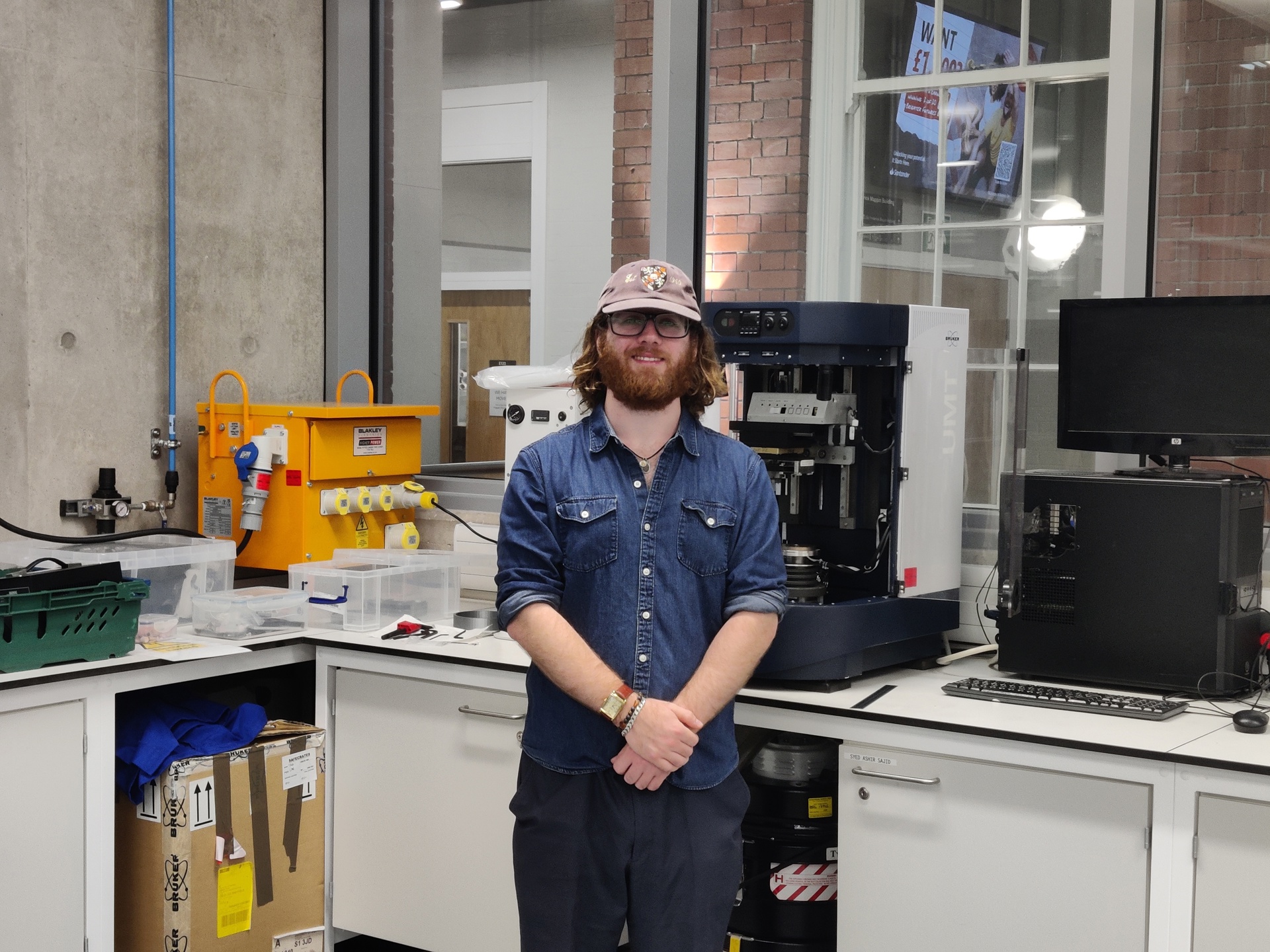
For Damien Dooley, a PhD candidate at the University of Sheffield, this challenge defines his doctoral research. Through a doctoral project sponsored by John Crane, Damien is focusing on the development of novel ceramic materials that could enable more reliable hydrogen storage and handling, supporting a more economically viable clean energy transition.
“My interests have always been in materials development and synthesis,” Damien explains. “I wanted my research to be in an area where it could eventually help people and contribute to something meaningful.”
From natural sciences to materials research
Damien completed his BA (Hons) in Natural Sciences at the University of Cambridge earlier this year, specialising in Materials Science. His academic interests focus on how materials are designed, synthesised and selected for demanding applications where performance, durability and cost are critical.
Rather than considering materials in isolation, his studies emphasised how material properties influence system-level outcomes. That perspective now underpins his doctoral research, where materials performance directly affects whether emerging energy technologies can move from concept to deployment.
“I've always been interested in research that connects fundamental science to real-world use,” he says. “Materials often determine whether a technology succeeds or fails, especially in challenging environments.”
That mindset influenced his decision to pursue a PhD in applied materials research with clear industrial relevance.
Choosing a project with academic and industrial depth
Damien discovered the PhD project while reviewing doctoral opportunities online and was immediately drawn to its focus on developing novel ceramics for hydrogen storage. The technical challenge was ambitious, forward-looking and closely aligned with the increasing role hydrogen is expected to play in global energy systems.
After initial discussions with the University of Sheffield and John Crane, Damien visited John Crane's manufacturing and R&D facility in Slough. That visit helped translate the project description into a practical context, illustrating how materials research directly links to engineered components and real operating conditions.
“The opportunity to work in both academic and industrial environments really stood out,” Damien notes. “It felt like a chance to develop a wide range of skills while working on something genuinely relevant to future energy systems.”
He accepted the role and relocated to Sheffield in September 2025 to begin the project, joining a cohort of doctoral researchers working across a wide range of technical disciplines.
Materials as a limiting factor in clean energy technologies
In hydrogen processing and storage, materials selection often acts as the primary constraint. Components must tolerate high mechanical loads and abrasion, reactive environments and long operational lifetimes, all while remaining economically viable to manufacture at scale.
Damien's research directly addresses these constraints. His focus lies in developing ceramic materials capable of handling wear and mechanical loading conditions associated with hydrogen-related applications, particularly in sealing and containment environments where performance and reliability are critical.
“Whether a technology succeeds often comes down to whether the material can meet functional demands, survive long enough in service and be produced economically,” Damien explains. “All of those factors matter at the same time.”
Rather than pursuing incremental improvement alone, the research explores new material systems that could expand the operating limits of hydrogen components.
Supporting a viable energy transition
While hydrogen holds significant promise as a clean energy carrier, widespread adoption depends on both technical performance and economic feasibility. Materials that degrade too quickly or prove too expensive to manufacture can slow progress.
By targeting material performance as a core enabler, Damien's research aims to help remove barriers to adoption. This supports longer component life, reduced maintenance and more predictable operation.
“As this area of work grows, the ideal outcome is that moving away from fossil fuels becomes feasible for more companies,” Damien says. “That's when research can start to make a real difference for global sustainability.”
Learning through collaboration and shared expertise
Although still early in the PhD journey, collaboration has already played a defining role in Damien's experience. Working alongside doctoral students from different research backgrounds has provided inspiration and exposure to approaches outside his immediate field.
He has also worked closely with Ahmed Mohamed, the other John Crane-sponsored PhD candidate at the University of Sheffield, particularly in setting up a friction testing environment.
“Ahmed's background is in computational fluid dynamics, which I know very little about,” Damien says. “Learning from him has been incredibly valuable and has sparked my interest in expanding my own skill set.”
That shared learning environment highlights the benefit of interdisciplinary research, especially within industry-linked programmes.
Gaining insight into academic and industrial pathways
One of the advantages of an industry-sponsored PhD is exposure to multiple potential career paths. Through interactions with academic supervisors and industry engineers, Damien is gaining insight into how applied research translates into long-term roles across sectors.
At this stage, he remains open-minded. Both academia and industry appeal, and the PhD will help clarify which path is right for him.
“If I moved into industry, I would really like to work in a research and development team,” he explains. “Materials development or forensic materials science, where you investigate and prevent device failures, would be particularly interesting.”
If he chooses to remain in academia, a postdoctoral role in biomedical materials research is also a potential path forward.
Advice for future PhD candidates
Drawing on his experience so far, Damien encourages future PhD candidates, particularly those considering industry-linked projects, to choose roles that are connected to genuine personal interests.
His advice includes:
- Stay open to collaboration and learning from others
- Use industry-linked PhDs to explore different career options
- Learn from both academic and industrial perspectives
“Being open to the people around you, helps you develop as a more rounded scientist,” Damien notes. “Industry collaboration gives you a much broader view of how applied science works today.”
Turning materials research into impact
Damien Dooley's doctoral research highlights the critical role materials science plays in enabling the clean energy transition. By addressing one of the key limiting factors in hydrogen technologies, namely materials performance, his work connects laboratory research with real-world applications.
Through John Crane's sponsorship and collaboration with the University of Sheffield, this research combines academic rigour with industrial relevance, ensuring that materials capability keeps pace with the ambitions of next-generation clean energy systems.