
A contemporary guide to mechanical seal leakage: 13 common causes of failure
Mechanical seals replaced older packaging rings to reduce pump seal leakage and improve reliability. They restrain product leakage around the pump shaft with two flat surfaces, one stationary and one rotating.
However, despite their advantages, mechanical seal failure remains one of the leading causes of pump downtime. To avoid this, it’s essential to apply the proper seal for the intended function.
A seal can be exposed to a wide variety of operating conditions, sometimes very different from conditions the seal was intended for, which can cause issues down the line. However, even if a seal is the proper one for the job, it can still fail faster than anticipated.
When a seal leak occurs, it often indicates deeper issues that require rapid diagnosis and mechanical seal failure analysis to prevent further equipment damage.
Why mechanical seal failure happens
Mechanical seal failure can occur due to poor lubrication, improper installation, incorrect seal selection or unexpected operating conditions. A pump seal leak is often the first visible sign that something has gone wrong. Understanding these early indicators is essential for reducing pump seal failure and avoiding unplanned downtime.
Causes of mechanical seal failure
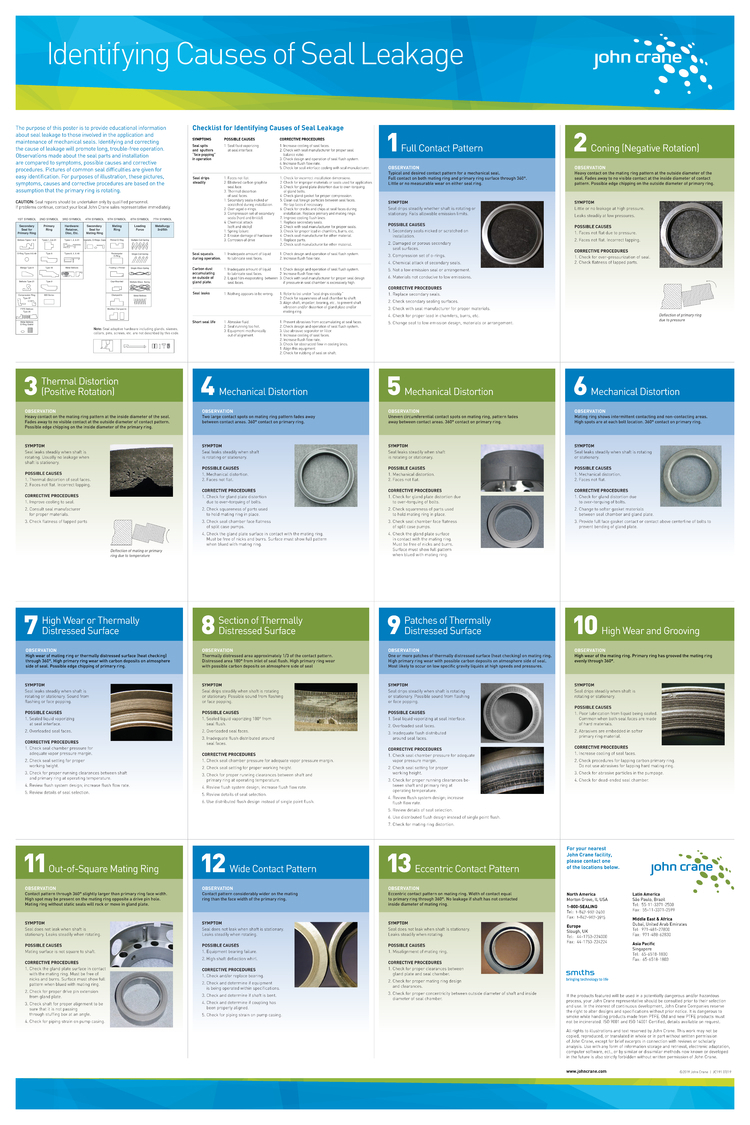
1. Full contact pattern
A healthy mechanical seal shows full contact on both mating and primary ring surfaces with minimal wear. If a seal leaks while the shaft is stationary or rotating, it’s often due to damaged or misinstalled secondary seals, unsuitable materials or design issues, which can be corrected by inspecting, replacing or upgrading the seal to a low-emission design.
2. Coning (negative rotation)
When a mechanical seal shows heavy contact at the outside diameter but little or no contact at the inside, it may also exhibit edge chipping on the primary ring. This can cause steady leakage at low pressure despite minimal leakage at high pressure, typically due to uneven or improperly lapped faces, and can be corrected by checking for over-pressurisation and ensuring the seal faces are flat.
3. Thermal distortion (positive rotation)
When a mechanical seal shows heavy contact at the inside diameter and little or no contact at the outside, the primary ring may also exhibit edge chipping. This often causes steady leakage while the shaft is rotating, typically due to thermal distortion or unevenly lapped faces, and can be addressed by improving cooling, verifying flatness and consulting the seal manufacturer for proper materials.
4. Mechanical distortion
Two contact spots on the mating ring with gaps can cause steady leaks even if the primary ring is fully contacting. Check for mechanical distortion, uneven faces and ensure gland plate and seal surfaces are flat and free of nicks.
5. Mechanical distortion
Uneven contact spots on the mating ring, even with full contact on the primary ring, can cause the seal to leak steadily. Inspect for mechanical distortion, uneven faces, and ensure gland plate and seal surfaces are flat and free of nicks or burrs.
6. Mechanical distortion
Intermittent contact on the mating ring, with high spots at bolt locations, can cause the seal to leak steadily. Check for mechanical distortion, use softer gaskets and ensure full gasket contact to prevent gland plate bending.
7. High wear or thermally distressed surface
Steady leaks and popping sounds can result from high wear or thermal damage on the mating and primary rings. Causes often include vaporising liquid at the seal interface or overloaded seal faces, which can be addressed by checking seal chamber pressure, verifying running clearances, reviewing flush system design, and confirming proper seal selection and installation.
8. Section of thermally distressed surface
Thermal distress in the contact pattern, often opposite the seal flush, can cause steady leaks and occasional popping. This usually results from vaporising liquid, overloaded faces or uneven flush distribution. It can be corrected by checking chamber pressure, seal setting, running clearances, reviewing flush design and ensuring proper seal selection, ideally with a distributed flush.
9. Patches of thermally distressed surface
Thermally distressed patches on the mating ring, combined with high primary ring wear, can cause steady leaks and popping sounds, especially with low-specific gravity liquids at high speeds. This is usually due to vaporising liquid, overloaded faces or an uneven flush, and can be corrected by checking chamber pressure, clearances, flush design, seal selection and mating ring condition.
10. High wear and grooving
High wear on the mating ring, caused by the primary ring grooving it evenly through 360°, can lead to steady leaks whether the shaft is rotating or stationary. This is often due to poor lubrication or abrasives in the pumped liquid. It can be corrected by improving cooling, following proper lapping procedures, checking for abrasive particles and ensuring the seal chamber isn’t dead-ended.
11. Out-of-square mating ring
A contact pattern slightly larger than the primary ring, with potential rocking of the mating ring, can cause the seal to leak while rotating but not when stationary. This usually results from a misaligned mating surface and can be corrected by checking the gland plate and mating surfaces, drive pin alignment, shaft alignment and ensuring the pump casing is free of piping strain.
12. Wide contact pattern
When the mating ring contact pattern is wider than the primary ring face, the seal may leak during rotation even if it’s fine when stationary. Causes often include bearing failure or excessive shaft deflection, so it’s important to inspect bearings, check shaft and coupling alignment, and ensure the pump casing is free of piping strain.
13. Eccentric contact pattern
An eccentric contact pattern on the mating ring can cause the seal to leak while rotating, but not when stationary. Correct this by checking gland plate clearances, mating ring design and shaft-to-chamber concentricity.
Click here or on the graphic below to view the thirteen most common types of seal failure, including diagnostic symptoms, causes and corrective procedures.
Common questions
How does a mechanical seal prevent leakage?
A mechanical seal prevents leakage by using two extremely flat, opposing faces, one rotating and one stationary, to control fluid escape. A thin lubricating film sits between the faces, minimising friction and preventing pump seal leakage while keeping contaminants out of the sealing interface.
What causes mechanical seal failure?
Mechanical seal failure often results from poor lubrication, contamination, incorrect seal selection, misalignment or improper installation. These issues lead to heat, wear and deformation, causing a leaking seal or full pump seal failure. Early inspection and monitoring help reduce mechanical seal failure.
How common is an oil pump seal failure?
Oil pump seal failure is relatively common, especially in systems exposed to high temperatures, vibration or contaminated fluids. A pump seal leak often develops gradually, with early symptoms like minor leaks or reduced efficiency. Regular maintenance helps prevent oil-related seal failure.